


While traveling along a lonely stretch of Highway 126 near Fillmore, CA, prominent fantasy and science-fiction writer Richard Matheson and fellow writer Jerry Stohl were relentlessly pursued by an 18-wheeler semi-truck operated by an unseen driver. Riding them close enough to completely block out their rearview mirror, the truck lurked just inches from their rear bumper, its roof-mounted air horn continuously venting its road-rage-induced vitriol as both vehicles continued accelerating at an alarming rate. The terrifying pursuit lasted just a few minutes before the truck slowed to exit the highway toward an unknown destination.
The deeply unsettling incident left both men shaken, made even more haunting by the fact that the day was Friday, November 22, 1963, just a few hours after the assassination of President John F. Kennedy. The unhinged highway nightmare made a traumatic impression on Matheson, inspiring his short story “Duel,” published in April 1971. Rights were immediately acquired by Universal Studios to be produced as an ABC Saturday night “Movie of the Weekend” to broadcast later that same year.
And, as the first movie directed by a young 24-year-old filmmaker named Steven Spielberg, Duel became a landmark in suspense-driven storytelling.
David and Goliath
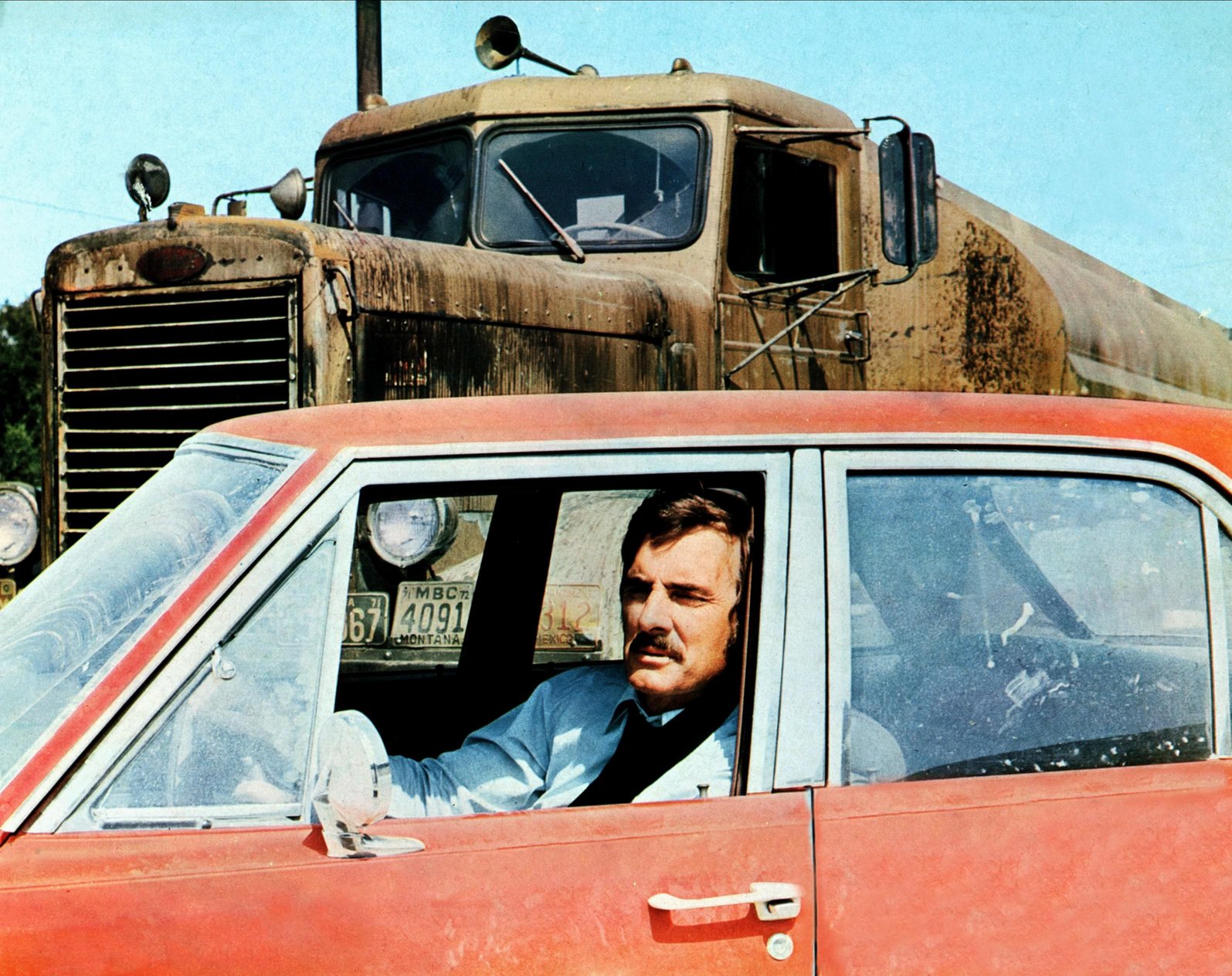
At its core, Duel is brutally simplistic. Adapted into a full-length script by Matheson, based on his original short story, the film’s protagonist, David Mann, played by Dennis Weaver, is a salesman en route to a client meeting, driving through the California desert in his bright red 1970 Plymouth Valiant. After passing a decrepit, slow-moving gas tanker truck on a two-lane highway, Mann unknowingly triggers what is about to become a terror-charged pursuit to the death. With no elaborate backstory getting in its way, the brilliance of Duel lies in its restraint from classic narrative storytelling to bring a man versus monster scenario of psychological torment to life, a prelude to similar themes Spielberg would utilize to terrify audiences again just a few years later.
Searching for something that embodied pure menace to serve as cinema’s first vehicular villain, Spielberg looked at ten big rigs, settling on the 1955 PeterBilt 281. Drawn to the lack of modernization it displayed with its elongated hood, circular headlights, split windshield, and attached 1940s-era tanker trailer, the PeterBilt 281 possessed a warped, almost grotesquely monstrous visage. Beneath its hood, it housed a Caterpillar 1673 turbocharged diesel engine that generated 280 horsepower, paired with a Fuller RTO-913 13-speed “Roadranger” single stick manual transmission and a Rockwell TK-570 single drive axle.
To enhance its intimidating appearance, the filmmakers installed a non-functional dual-drive tandem tag axle to give it more visual heft. All recognizable identifiers were removed from the truck, which was then intentionally distressed using pressurized salt sanding and layered applications of motor oil and brake fluid to create a grimy, rusted-out appearance. Its grille and windshield were coated with dead insects and discolored specs of blood sourced from raw meat acquired at local grocery stores. A row of corroded license plates lined the expansive front bumper like mementos, hinting this hulking predator had been stalking victims across these desolate Southwest highways for decades.
Wanting a car for the film’s protagonist that immediately represented vulnerability, Spielberg chose the 1970 Plymouth Valiant to reflect Mann’s subdued personality and, with its blazing Tor-Red exterior paint, stand out amidst the earthy tones of the desert locales. Outmatched by his unseen pursuer in performance and capability on the scorching desert asphalt, the Valiant featured a 225 cubic-inch 3.2L Slant-Six engine that generated only 125 horsepower.
Tales From Hell’s Highway
When virtually all made-for-television projects were filmed on studio lot soundstages, Spielberg insisted on shooting Duel almost entirely on location across Southern California, including stretches of Agua Dulce Canyon Road, Soledad Canyon Road, and the Sierra Highway throughout its 13-day production schedule. With its extremely limited $450,000 budget, this was an unconventional and risky decision.
The truck may have looked like an unstoppable killing machine sitting idle, but it lacked the intimidating performance and capability Spielberg wanted in motion. Even with legendary Hollywood stunt drivers Carey Loftin and Bill Hickman taking turns behind the wheel of the PeterBilt truck — as the driver is never revealed beyond a brief glimpse of a boot and a sunburnt arm — and Dale Van Sickel sitting in for Dennis Weaver for the more dangerous Plymouth Valiant maneuvers, a number of creative photography tricks were required.
With the 1955 PeterBilt 281 limited to 65 MPH and prone to overheating under the scorching desert sun long before reaching that speed, Spielberg and director of photography Jack Marta decided to film the chase sequences at low angles, undercranking the cameras to shoot at 18 or 20 frames per second (fps) instead of the standard 24 fps and, whenever possible, filming on downhill grades. The clever techniques worked, giving both vehicles the realistic appearance of moving at dangerous rates of speed. To save time and money, the production filmed mostly on the same two-mile-long stretch of highway using five cameras that were constantly moved around so no background ever looked the same.
A total of four PeterBilt trucks were acquired for Duel, including the 1955 PeterBilt 281 that served as the master truck and others dressed to match its weathered, rusted-out hues as much as possible. They mostly served as back-ups and for sourcing spare parts whenever the master truck would overheat or break down; while one was cooling down, filming continued with another. Four Plymouth Valiant models were also used throughout production, including the 1970 master car for beauty and wide-angle shots, and a 1969 model with a 318 cubic-inch V8 engine that was modified to match the 1970 model for high-speed stunt driving. A third was equipped with front and driver’s side camera mounts for close-up footage of Weaver behind the wheel. A fourth Plymouth Valiant — a 1971 model — was acquired for footage needed for the film’s international theatrical release.
Terror Goes Theatrical
When then president of Universal Television, Sid Sheinberg, and producer George Eckstein liked the raw footage dailies they were seeing, they decided to give Duel an international theatrical release. As the original television film had a 74-minute running time, Spielberg, Weaver, and much of the production crew returned a few months later to shoot additional footage to reach the minimum 90-minute running time required for international theatrical films. This included shooting several new scenes for the sake of narrative and character development, as well as a tense encounter with a stranded school bus and a harrowing scene at a railroad crossing of the truck attempting to push the Valiant into a passing freight train.
For the international footage, the production acquired and modified a 1960 PeterBilt 351 that didn’t quite match the original 1955 truck, which was no longer available. As the international cut is the only version of Duel currently available today, it’s rather easy to notice the physical differences and inconsistencies of the truck design, coloring, and damage that creep in from scene to scene. To some, these can be viewed as simple production errors, while others see this evil monstrosity growing filthier and more aggressive as the pursuit continues, morphing into something completely supernatural.
The whereabouts of these vehicles today remain shrouded in mystery, with conflicting stories of the 1960 PeterBilt 351 used for the international footage still existing in a private collection. To reveal the fates of the other PeterBilt and Plymouth Valiant models used throughout the production risks spoilers to readers who have not yet experienced Duel and its final confrontation.
Duel and the Road to Jaws
More than half a century later, Duel remains one of the highest-rated and most acclaimed television films ever produced. For Steven Spielberg, it was the beginning of something far greater, the road ahead leading to a career of monumental blockbusters that would reshape the film industry. The narrative and thematic influence Duel had on Jaws is undeniable, with Spielberg often saying without the experience making the former, he would not have directed the latter. Both films transport viewers from familiar environments into hostile, isolated territories; their meek, yet cunning protagonist(s) battling unseen primal forces of nature to the death.
Be warned. On the dangerous road to Duel, those lurking objects in the mirror are definitely closer than they appear.