


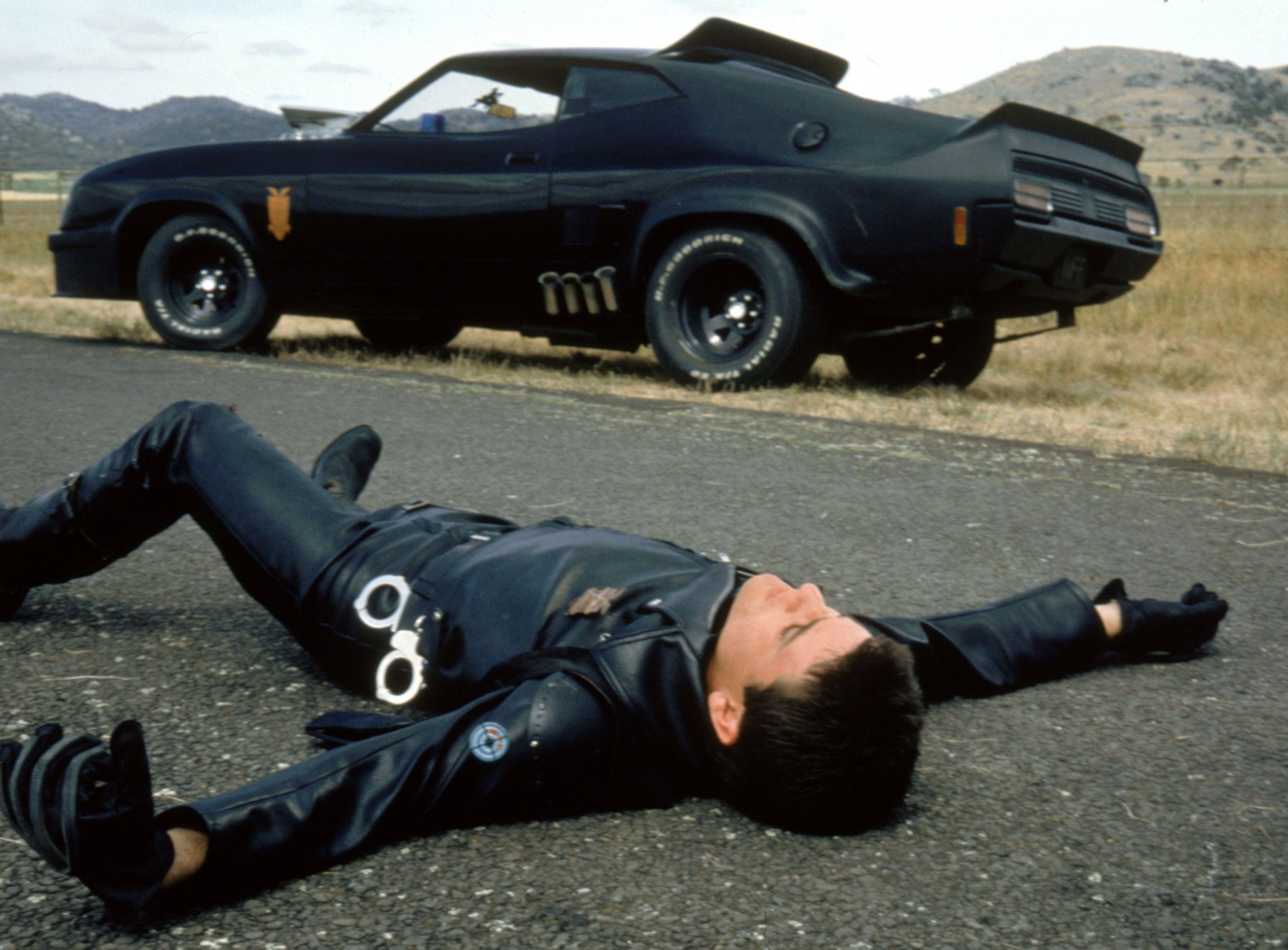
It’s a high-performance icon that goes by many names. The V8 Interceptor. The Pursuit Special. The Black on Black. The Last of the V8s. No matter what the collective memory of cinema fandom refers to it as, the heavily modified 1973 Ford Falcon XB GT coupe from visionary Australian filmmaker George Miller’s post-apocalyptic cult action films Mad Max (1979) and Mad Max 2: The Road Warrior (1981) has become something truly mythic as one of the most recognizable cars in Hollywood history.
Traversing the chaotic violence and reckless speed of societal collapse, the V8 Interceptor — as the car will be referred to throughout this retrospective — became a symbol of vengeance in a fractured, near-future Australia where law and order teetered on the brink in the first film, then later emerged from the ruins of the blasted post-nuclear war wasteland setting of its sequel. In both films, this legendary car was driven by a Melbourne patrolman-turned lone avenger named Max Rockatansky, a role that launched the career of a young, unknown actor named Mel Gibson, who was only 21-years-old during the production of Mad Max in 1977.
Horsepower is Survival
Not only his primary vehicle, the V8 Interceptor also served as Max’s home; both survivors of an unseen war that ravaged the planet between the timelines of each film. The events of Mad Max told the story of vengeance amidst a period of escalating lawlessness and anarchy. Mad Max 2: The Road Warrior was an even darker tale of survival in a shattered world without rules, taken over by murderous scavengers amidst violent clashes of good versus evil in the relentless chase for something far more precious than food and water — gasoline.
Converted from a Main Force Patrol (MFP) car into a supercharged, matte black-painted hellraiser Max used as a deadly weapon of retribution in the final act of the first film, the V8 Interceptor, now a further-modified, battered shell of its former self in the sequel, lived on as the last civilized monster left standing amidst endless landscapes of brutality and dystopian despair.
Modified for the Apocalypse
Long before its big screen debut, Max’s V8 Interceptor began its existence as a 1973 Ford Falcon XB GT coupe. Originally built by Ford Motor Company in Detroit, MI, between 1960 and 1970 as a more conservative compact vehicle with a squared-off design styling that inspired the look of the 1964 Ford Mustang, production on the Falcon was halted in America in 1970 and continued exclusively by Ford Australia. The Australian design for the Falcon was gradually transitioned into a more performance-focused driving machine that, ironically, took stylistic inspiration from the Ford Mustang Fastback, as well as the Ford Torino and other American pony and muscle cars of the era. Intended as a racer, the car was introduced in its two-door hardtop GT model configuration as the 1972 Ford Falcon XA; the sleeker, more dynamic XB series was introduced in 1973. Beneath the hood, the 1973 Ford Falcon XB GT coupe was powered by a 351 cubic-inch 5.8L Cleveland V8, delivering roughly 350 horsepower and 380 pound-feet of torque, paired with a four-speed manual transmission.
With its sweeping contours, low-slung stance, and Coke bottle profile, the 1973 Ford Falcon XB GT coupe embodied a powerful, aggressive, and menacing persona that attracted director George Miller and producer Byron Kennedy as the ideal vehicle for Max Rockatansky. The car’s Australian build also made accessible parts readily available from local sources for quick on-set repairs.
The original Mad Max film was limited to a $380,000 production budget (roughly $1.8 million today), with a mere $20,000 allotted for acquiring and modifying vehicles used throughout the film. To bring Miller and Kennedy’s vision for Max’s car to life, a standard 1973 Polar White Falcon XB GT coupe was handed over to Melbourne-based custom shop Graf-X International. Their mission was to reshape this production muscle car into something that looked capable of surviving the end of the world.
The transformation into the V8 Interceptor was quite radical, including the installation of a Monza front, giving the car one of its most recognizable features. Other modifications included its two-tone black-on-black paint, zoomie-style chrome exhaust pipes on either side, and BF Goodrich® Radial T/A white-lettered tires with 18-spoke mag rear wheels. Bolstering its onscreen menace, the car was also equipped with a Weiand twisted-vane blower drive unit supercharger with a GM 6-71 case and a Scott fuel injector hat protruding from the hood. Though non-functional for performance purposes, the supercharger was paired with an electric motor to activate and deactivate on command using an electrical switch on the gear shifter, creating the illusion of forced induction output.
With the film’s extremely low budget, this would be the only V8 Interceptor acquired and modified for the film. Money was tight, so the car also served as one of the few production vehicles hauling crew and equipment from location to location between shots. Despite these limitations, the film featured some of the most groundbreaking action sequences ever captured, with Australian racing driver Phil Brock handling the most dangerous stunts involving the V8 Interceptor.
Evolution Into a Road Warrior
Upon its 1979 release, Mad Max became an international sensation, eventually grossing over $100 million worldwide, with its return on investment earning a place in the Guinness World Records for the highest profit-to-cost ratio of any film at the time. When a sequel, Mad Max 2: The Road Warrior, was greenlit for production a year later, the original V8 Interceptor from the first film was called back into duty, modified further to suit its devastated, fuel-starved wasteland surroundings. Its sleek black sheen was deliberately aged and distressed, bearing the scars of battle and harsh elements. The trunk was removed to allow the installation of twin rear-mounted cylindrical fuel tanks, while the front end was raised for better ground clearance on off-road terrain.
A far larger $4.5 million production budget for the sequel let George Miller and his team take the film’s action sequences to the next level. To accommodate the increased demands of the film’s more intense stuntwork, a near-identical replica V8 Interceptor was created, this one modified from a 1974 Ford Fairmont XB GS Hardtop for wide-angle photography and to handle the more intense high-speed driving sequences. The original V8 Interceptor was reserved for close-ups and interior shots.
With its perfectly executed balance of action and suspense, Mad Max 2: The Road Warrior was bigger, faster, and louder in every way, praised to this day by critics and legions of fans around the world as one of the greatest action films ever made.
Rediscovery and Restoration
When production wrapped on the original Mad Max in 1978, and with no idea a sequel would be made, the V8 Interceptor was given to the film’s production mechanic, Murray Smith, in lieu of payment. With movie cars having little perceived value back in the day, Smith struggled to find a buyer. Following its on-screen use in Mad Max 2: The Road Warrior, the V8 Interceptor spent years in obscurity until Mad Max film enthusiast Bob Fursenko tracked it down deteriorating in a South Australian wrecking yard in the mid-1980s. Following its rescue, the V8 Interceptor underwent a comprehensive $25,000 restoration, returned to its pristine Mad Max on-screen condition while retaining the dual fuel tanks from the sequel.
Following several years of being toured around various car shows and other events throughout Australia, the V8 Interceptor was acquired by British collector Peter Nelson in 1993 and displayed with prominence in the Cars of the Stars Motor Museum in Keswick, Cumbria, in North West England. In 2011, the car was obtained by real estate developer and car collector Michael Dezer and relocated to his Miami Auto Museum, where it remains today.
The “Last of the V8s” Legacy
Few famous movie cars achieve the status of popular culture immortality as much as the Mad Max V8 Interceptor has throughout the decades. From meticulously detailed, full-scale fan-built replicas and prominent appearances in commercials, video games, and films like Steven Spielberg’s Ready Player One, the V8 Interceptor continues to have a resounding impact on global car culture.
When George Miller decided to come out of semi-retirement to direct and co-write Mad Max: Fury Road in 2015 — which features the brief appearance of a newly created V8 Interceptor driven by actor Tom Hardy, now portraying wasteland loner Max Rockatansky, in its opening sequence — and Furiosa: A Mad Max Saga in 2024, he did so for the fans, knowing the time was right to reintroduce his post-apocalyptic vision to a new generation.
Even in the face of chaos and collapse in the world of Mad Max, the V8 Interceptor still resonates.