


It began as a fever dream.
While asleep in a Rome hotel room recovering from food poisoning in 1981, filmmaker James Cameron had a nightmare. It was a hellish vision of a chrome skeleton emerging from a fiery inferno and crawling toward him, reaching out as the flames reflected off its outstretched mechanical arm and fingers. The frightening image startled him awake, and within seconds he was sketching out this sinister presence on hotel stationery, every detail seared into his memory. Three years later, that vision was fully realized in Cameron’s groundbreaking 1984 techno-thriller that redefined the future of science fiction/action filmmaking. It was no longer a dream. This time it was terrifyingly real. It was cold. It was inhuman. It was relentless. It was unstoppable.
It was The Terminator.
Seven years after the success of the original film, director/co-writer Cameron unleashed its estimated $100 million sequel, Terminator 2: Judgment Day (T2), on the world during the summer of 1991, bringing back the thrilling mankind versus machines spectacle of the first film with its groundbreaking fusion of cutting-edge visual and practical effects, and some of the most jaw-dropping stunts ever captured on film.
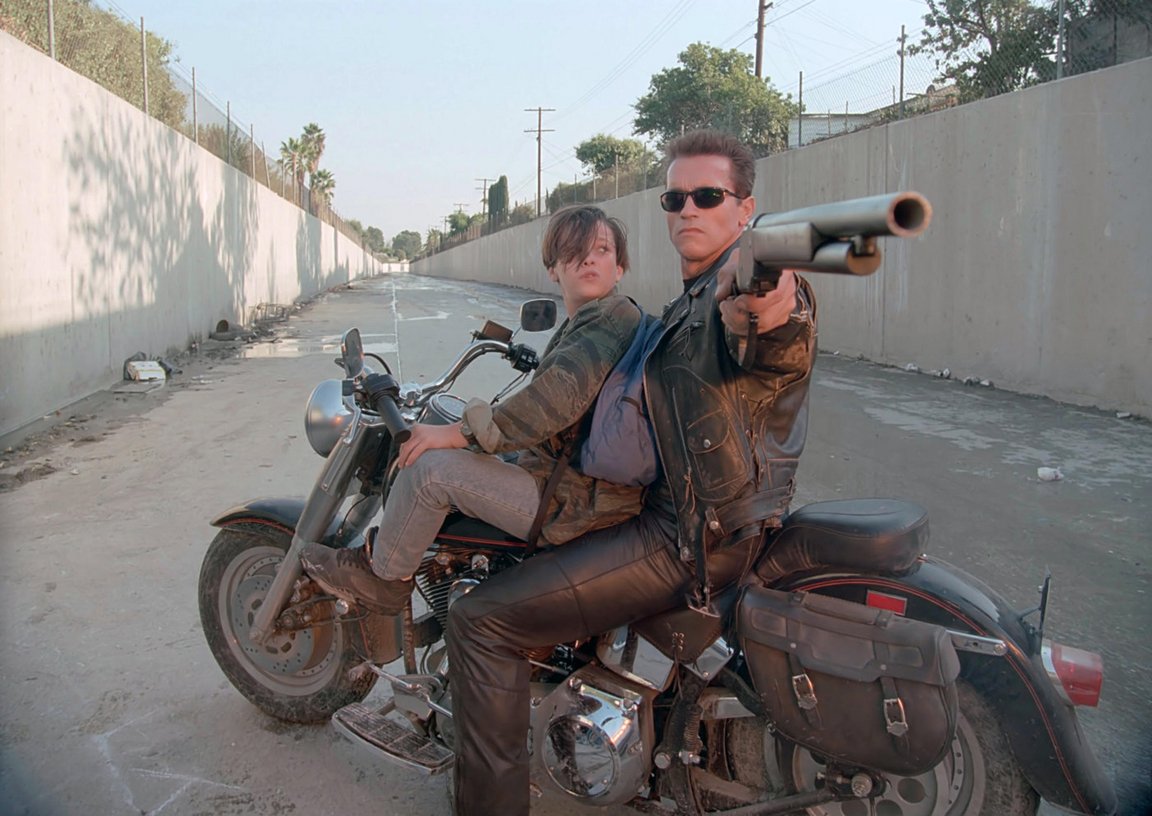
Widely regarded as one of the defining action films of the last half-century, T2 unfolds as an unrelenting race against time, with the fate of humanity resting on the survival of a young boy named John Connor, the future leader of the human Resistance during the War Against the Machines. With him is an unlikely guardian, a leather-clad cybernetic warrior — the T-800 cyborg infiltration unit — sent through time from a nuclear-ravaged future who becomes Connor’s protector, tactical mentor, and, in many ways, surrogate father, whose revved-up ride of choice is the 1991 Harley-Davidson® Fat Boy®.
Bad to the Bone
Introduced by Harley-Davidson in 1990, the Fat Boy (Model FLSTF) was a heavyweight cruiser featuring broad proportions and a bold, industrial visage that seemed almost tailor-made for the Terminator franchise, hitting the market when T2 was in pre-production. Designed to compete with the rising popularity of imported motorcycles from Japanese brands like Honda, Yamaha, Suzuki, and Kawasaki, the Harley-Davidson Fat Boy was the polar opposite of their lightweight bikes, boasting its signature heft and muscular American styling. Specific features aligned to its “FLSTF” model identifying designation included solid aluminum disc wheels, heavy-duty wide-set handlebars, a shotgun exhaust, beefy fenders and tires, a 39-millimeter telescopic fork front suspension, hidden dual preload-adjustable rear suspension shock absorbers, a single 292-millimeter disc with four-piston calipers, and a Softail chassis, which concealed its rear suspension beneath a rigid-frame-inspired profile.
Powering this behemoth was a standard 1,337cc, 81 cubic-inch air-cooled, four-stroke Evolution V-twin engine that generated 67 horsepower and 72 pound-feet of torque. Paired with a five-speed manual transmission, the Fat Boy had a top speed of 92 MPH.
The Harley-Davidson Fat Boy that appears throughout T2 is the 1991 model. However, keen eyes will notice a continuity error with the Fat Boy model commandeered by Schwarzenegger’s T-800 at the Corral Bar in Lake View Terrace, CA, toward the beginning of the film. It reveals specific head-up display (HUD) information that only appeared on pre-factory production prototypes for 1990 models.
Cool Rider
Five 1991 Harley-Davidson Fat Boy bikes, each painted in Midnight Black with red pinstriping, were acquired for the T2 production at a cost of $13,000 each. Cameron specifically chose this model because he preferred muscle over speed to align with Arnold Schwarzenegger’s imposing physique. Two were designated hero bikes, remaining largely stock for close-up shots of the actor. Others were modified for elaborate stunt work and high-speed chase sequences, including exhaust alterations, carburetor rejetting, and respringing the valves for sharper throttle response and acceleration.
Fully fueled, a factory-standard Fat Boy weighed approximately 657 pounds, but performance adjustments and added equipment for the film’s production increased its weight to 780 pounds, requiring elaborate practical effects to pull off certain stunts.
Launching Full Throttle
One of the defining moments for the Fat Boy in T2 is the four-minute high-speed chase sequence with the advanced liquid metal prototype assassin T-1000 behind the wheel of a full-size Freightliner semi-truck barreling after John Connor’s Honda XR dirt bike through the Los Angeles drainage canal system. Following from the streets above is the T-800 on his Fat Boy, attempting to find a way to get down the concrete channel to intercept the T-1000. His only chance is an impossible maneuver that is considered one of the greatest stunts ever performed.
The stunt required a full-size 780-pound Harley-Davidson Fat Boy to ramp off of a canal bridge, with a jump distance of 85 feet and a drop height of approximately 40 feet, directly onto the concrete ground below. To maintain realism, director James Cameron rejected the idea of using a lightweight substitute motorcycle and insisted on using one of the stunt-modified Fat Boy cycles. Longtime Schwarzenegger stunt double Peter Kent was tapped to make the jump, having spent six weeks training on the Fat Boy before production began to familiarize himself with its accelerating patterns, weight distribution, turning radius, and braking capabilities.
To compensate for the considerable weight of the Fat Boy, stunt coordinator Joel Kramer devised a rather ingenious support system that greatly reduced the motorcycle’s drop weight while in mid-jump. This involved the use of construction cranes positioned off-camera with reinforced steel cables tethered between and attached to both an eight-foot spreader bar, the Fat Boy, and a stunt truck that pulled Kent and the motorcycle off of the bridge at about 35 MPH. This allowed the bike to hover mid-air and greatly reduce its landing impact to approximately 185 pounds. The rigging system and cables were digitally removed in post-production. Without this pulley system, the Fat Boy would have been destroyed on impact and potentially caused Kent serious, if not fatal, injury.
The stunt worked flawlessly on most of the seven takes Cameron ordered. A miscalculated landing on one take caused the brake assembly to shatter, preventing Kent from stopping before crashing into a concrete wall. It narrowly missed hitting Cameron head-on while he was operating one of the ground-level cameras.
Post-Apocalypse
The $517 million worldwide box office haul for T2 during the summer of 1991 made it a global phenomenon, which also catapulted the Harley-Davidson Fat Boy into its own stardom as a pop culture icon. Harley-Davidson saw a substantial uptick in Fat Boy sales for the 1991 model year, many configured with the same Midnight Black paint and red pinstriping seen in the film.
In June 2018, one of the original screen-used hero bikes ridden by Arnold Schwarzenegger, complete with scratches and dings obtained throughout production, sold at auction for $480,000 as part of the Icons & Legends of Hollywood auction hosted by Profiles in History. It had only 392 miles on its odometer. Today, its whereabouts are a mystery as its winning bidder was never made public. The second hero Fat Boy was fully restored in 2014 and is currently on display at the Harley-Davidson Museum in Milwaukee, WI, posed next to Peter Fonda’s iconic “Captain America” chopper from the classic 1969 film Easy Rider. The status of the three modified stunt Fat Boys is unknown.
No Fate
The deadly Cyberdyne Systems-built T-800 from The Terminator once promised it would be back. Seven years later, it returned — to the past — in T2 to save not only the Resistance leader, but all of mankind. 35 years later, T2 remains a landmark in modern filmmaking, revolutionizing computer-generated imagery (CGI) technology and propelling the film industry into the digital age. With its groundbreaking effects and explosive action sequences, T2’s legacy continues to ride on with that big, bad 1991 Harley-Davidson Fat Boy leading the charge toward Hollywood immortality.