


Four years before rocketing popular culture to a galaxy far, far away, filmmaker George Lucas took to the streets of his hometown of Modesto, CA, to direct his cinematic tribute to car culture, small-town life, and the pulse of late 1950s and early 1960s rock ‘n’ roll. But 1973’s American Graffiti wouldn’t exactly be the passion project he dreamed of making at the time. Following the poor reception of Lucas’ directorial debut, 1971’s stark dystopian sci-fi cult film THX 1138, it was a challenge from friend and fellow filmmaker Francis Ford Coppola for Lucas to make something more light-hearted and personal for his follow-up effort, a concept the young director had little interest in doing. But the challenge was accepted.
Conceived as a semi-autobiographical reflection of Lucas’ teenage years, American Graffiti distilled an entire generation’s rituals of cruising, drag racing, and listening to the likes of Wolfman Jack on late-night AM radio into one feverishly nostalgic summer night in 1962. As the newly-established Lucasfilm Ltd.’s first film production, American Graffiti was a love letter to hot-rod Americana that cast a regular who’s who of then-unknown actors at the time — Ron Howard, Harrison Ford, Cindy Williams, Suzanne Somers, and Richard Dreyfuss — to portray a handful of characters in this coming-of-age story of postwar youth culture. Lucas set out to make a film that captured the essence of a cultural crossroads where teenagers, cars, and rock ’n’ roll defined a lifestyle. The real stars of American Graffiti weren’t just the characters, the music, and the memories — they were also the cars. Those hot, hot cars.
Where Were You in ‘62?
For 18-year-old George Lucas, four months of that life-altering year were spent in a hospital bed recovering from the aftermath of an automobile accident that very nearly ended his life. Fueled by a lifelong passion for cars and a dream of becoming a racecar driver, Lucas’s aspirations were dashed in June 1962 when he barely survived a head-on collision that wrapped his modified Autobianchi Bianchina around a walnut tree near his Modesto, CA, home. Instead, the near-fatal incident directed his attention away from cars for the time being and onto other interests like history, sociology, and film; the latter garnering his acceptance into the School of Cinematic Arts at the University of Southern California in 1965. Less than a decade later, that passion for speed and high-octane performance remained, becoming the foundation for what would very soon become American Graffiti.
Serving as more than just a backdrop throughout the film, the many cars of American Graffiti are an embodiment of freedom, status, and identity in a shifting era for American youth. In his beloved film, Lucas captured both the nostalgia of a fading era and the enduring social connection and self-expression for an entire generation.
This September Hollywood Horsepower column is the first in a series paying tribute to the cars of American Graffiti that will continue in future pieces throughout the coming months. The cars are the real stars of Lucas’ classic — and there’s no better place to begin such a continuing retrospective than with the two cars that stole every second of screen time.
All Hail the Deuce: The 1932 Ford 5-Window Coupe
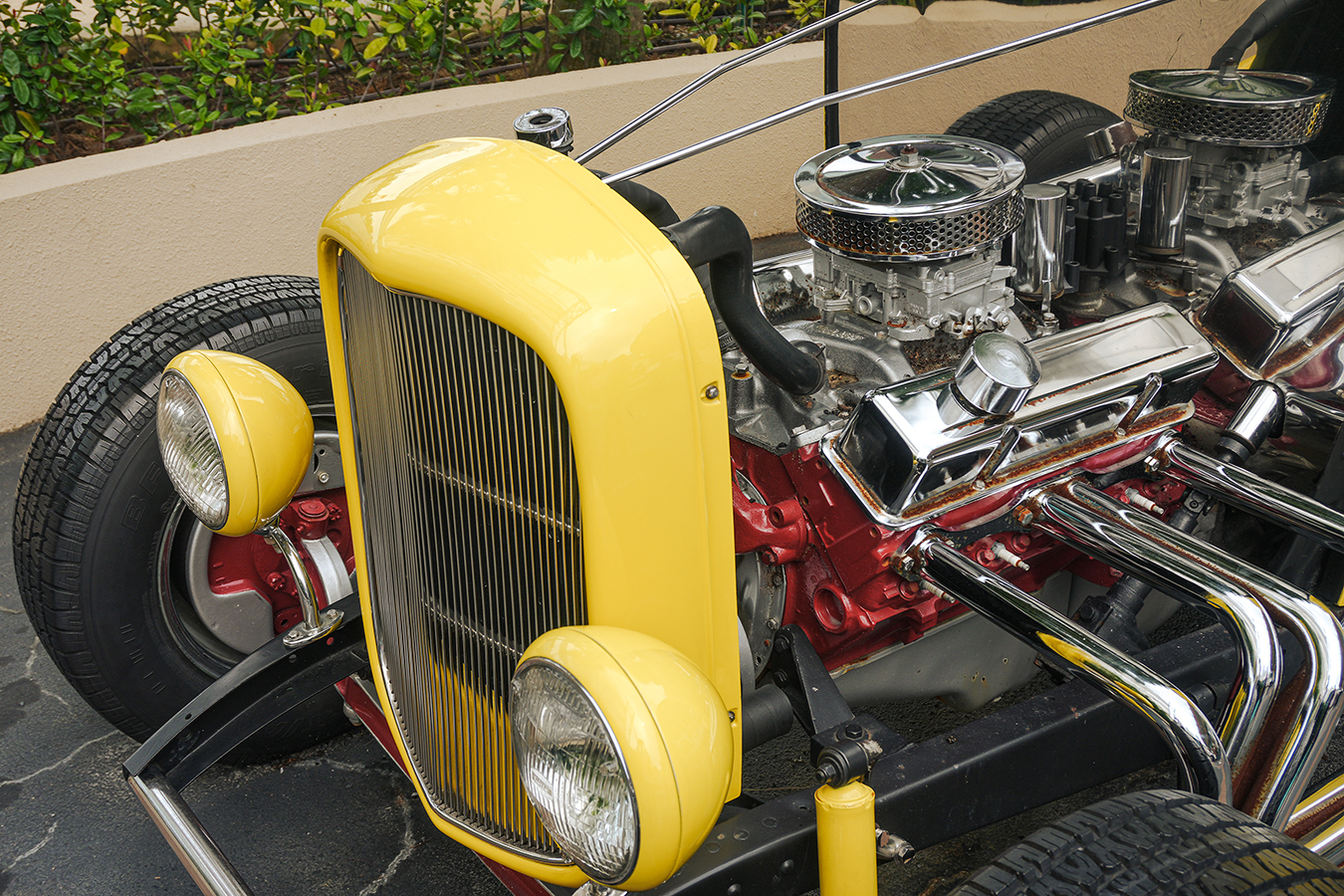
No car in American Graffiti carries more symbolic weight than eternal teenager John Milner’s bright yellow 1932 Ford 5-Window Coupe, nicknamed the “Deuce Coupe.” While the classic hot rod body stayed true to early-1960s cruising culture, the filmmakers upgraded its powerplant with a 350-horsepower 1966 Chevrolet 327 V8 fitted with aftermarket performance parts. These included a Man-A-Fre intake manifold with four Rochester 2G two-barrel carburetors and custom sprint car-style chrome headers. Despite its modernity for the story’s 1962 setting, the 327 V8 fit right in with its modified concoction of raw menace staring down the street race competition. With the American muscle era rapidly approaching, home-built hot rods like Milner’s were beginning to fade, replaced by the arrival of factory-produced muscle cars, like the 1964 Pontiac GTO, that were rolling out of Detroit. For Milner’s hot rod, Lucas insisted on a coupe with a chopped top to emphasize its low-slung, aggressive stance, a popular modification in the day.
The 1932 Ford 5-Window Coupe in American Graffiti became more than just the king of the Modesto streets. It embodied the rebellious spirit of early street racing and reignited public passion for the golden age of hot rodding. As a fun easter egg, the license plate for Milner’s car reads “THX 138,” an homage to Lucas’ previous film. Throughout the 1970s, Milner’s Deuce Coupe remained in the possession of Universal Studios before being sold in 1981 to Kansas City collector Steve Finch, who restored the car to its original movie appearance. In 1985, Finch sold the film’s Deuce Coupe to San Francisco car collector Rick Figari, who remains its owner to this day.
The Sporty Little Heartbreaker: The 1956 Ford Thunderbird
Where Milner’s Ford represents raw, street-shredding grit, the white 1956 Ford Thunderbird driven by the elusive blonde bombshell (Suzanne Somers) exudes pure mystique; a representation of desire, uncertainty, and chasing an unattainable dream. Setting it apart from the hot rods and street cruisers, George Lucas deliberately chose the ‘56 T-Bird because of its embodiment of mid-century elegance and aspirational style; its presence giving the character an almost dreamlike quality.
Blending sophistication with spirited performance, the 1956 Thunderbird stood out with its refined and alluring physique. Under the hood, the Thunderbird that appears in the film was powered by a 312-cubic-inch Y-Block V8 engine from a 1957 T-Bird model, with a Holley 4-barrel carburetor and automatic transmission, producing 215 horsepower. The T-Bird that appears in American Graffiti sold for $39,400 through Mecum Auctions in May 2019.
A Lasting Legacy
Few films have shaped automotive culture as profoundly as American Graffiti. More than half a century later, its impact on generations of movie fans and car enthusiasts extends well beyond its cinematic presence, rekindling interest in classic hot rods and sparking nostalgia for that bygone cruising era. Car shows nationwide feature replicas of Milner’s Deuce Coupe and Bob Falfa’s 1955 Chevrolet One Fifty — more on Falfa’s hellraiser in a future American Graffiti-inspired column. The film also helped define a cinematic sub-genre, with contemporary classics like Richard Linklater’s Dazed and Confused in 1992 echoing the cinematic themes of friendship, street freedom, and fast cars that Lucas so brilliantly captured in American Graffiti with a cinéma vérité-inspired documentary style. For Lucas, near-tragedy led to triumph, with the immense success of American Graffiti paving the way for his next directorial endeavor just a few years later — a small $12 million sci-fi adventure called Star Wars. But that’s a whole other performance-driven story…