


When “The Batman” first appeared in the pages of Detective Comics #27 in May 1939, this dark and brooding vigilante wasn’t yet the masked symbol of vengeance-fueled justice we recognize today from comic books and Hollywood blockbusters. When National Allied Publications — which eventually became DC Comics in 1977 — sought to replicate the explosive success of Superman from their anthology publication, Action Comics, the previous year, they commissioned artist Bob Kane and writer Bill Finger to create a new protector for the masses.
This new hero, however, would be the antithesis of the Man of Steel, a flesh and blood mortal who possessed no superhuman strength and whose origins were steeped in tragedy and forged by the lawlessness that plagued the corrupt and crime-ridden streets of Gotham City. Shifting from Superman’s wholesome “truth, justice, and the American way” creed of universal heroism, Batman was a product of a violent society, a masked symbol of retribution whose very presence instilled fear in the heart of the criminal element that created him.
From his beginnings, Batman’s war on crime demanded more than cunning and combat — it required ever-adaptable tools of intimidation. One being a powerful and menacing machine; a vehicle that matched Batman’s resolve as a symbol of tactical might and mythic presence.
A Batmobile that, for generations following, became as iconic as the Dark Knight himself.
“Does It Come in Black?”
From pulp comic books to film and television glory throughout the decades, the evolution of the Batmobile has evolved from a flashy crime-fighting coupe into a darker, more formidable icon of street justice. 20 years ago, the Batmobile faced a dramatic reinvention, shedding all traces of its sleek and futuristic extravagance from the 1980s and 90s, and reemerged as a heavily armored assault vehicle; a war machine built not for style, but for survival.
Introduced in 2005’s Batman Begins, the new Batmobile for the modern era was unlike anything Batman fans had ever seen before. It was big. It was bold. It was bumpin’.
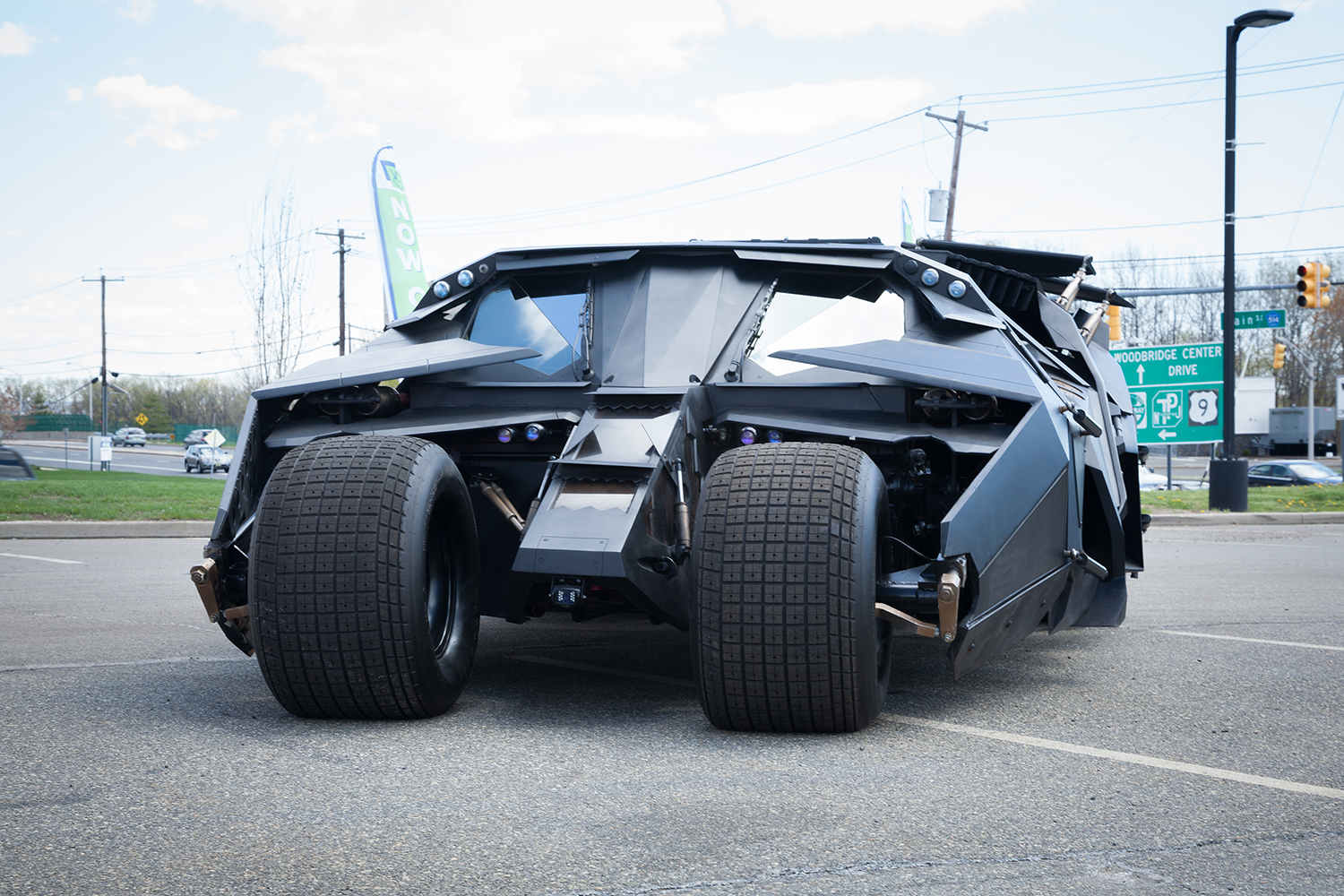
It was the Tumbler.
Rather than ascending from the gothic underworld of the Batcave, the origins of the Tumbler were steeped far more in realism than fantasy. As scripted by director and co-writer Christopher Nolan and co-writer David S. Goyer, the fictional Tumbler was conceived by Wayne Enterprises’ Applied Sciences Division as a military prototype for tactical bridging operations in war zones. Designed to leap rivers and chasms using a built-in jump system, the vehicle was never quite perfected. The concept was shelved and the prototype left to languish in underground storage — until Batman’s alter-ego, billionaire Bruce Wayne, recognized its potential for urban combat.
Throughout pre-production on Batman Begins, Nolan envisioned something completely different for the Batmobile — a fusion of a Humvee and a Lamborghini Countach, to be more precise. Working closely with concept designer Nathan Crowley, they chose to ignore past Batmobile designs and create a vehicle that looked like it was conceived by a defense contractor in a top-secret war room rather than the pages of a comic book. The result was a menacing urban assault tank and supercar hybrid that knocked audiences out of their theater seats.
“I Gotta Get Me One of Those!”
From its bespoke tubular steel frame chassis to its double wishbone front and multi-link rear suspension, the Tumbler was engineered from the ground up. Its armored body combined kevlar, carbon fiber, and steel; the matte black exterior evoking the menace of a stealth bomber. A 5.7-liter Chevy 350 ZZ3 V8 engine with a three-speed automatic transmission unleashed 500 horsepower from behind the cockpit, launching the two-ton machine from 0 to 60 MPH in under six seconds, topping out at 110 MPH. On the streets of Chicago — doubling for Gotham City — the Tumbler averaged 85 MPH on location throughout the film’s production in spring 2004, tearing through Chicago’s Loop and Lower Wacker Drive, across the Franklin Street Bridge spanning the Chicago River, and down a long stretch of the Amstutz Expressway near Waukegan, IL.
Other unique features on the Tumbler were a NASCAR-style rear axle for quick gear ratio changes and 44-inch Interco Super Swamper TSL tires. The front axle was removed entirely, allowing the cockpit to slide forward into “attack mode,” putting the driver in a prone position for lower visibility and added protection.
Distinctive rear fins from previous Batmobile designs were replaced with stealth fighter rear- and side hydraulic airfoils. The Tumbler’s rear jet-flame propulsion blasts throughout the chase sequences were generated by a propane-fed hot air balloon burner powered by a 1,500 horsepower high-performance gasoline and nitromethane formula-fueled jet turbine engine.
Among the Tumbler’s other tactical enhancements were stealth armor throughout the body, air-cooled machine guns and front cannons, halogen spotlights, self-sealing gel-filled front tires, axleless bolted wheel arm struts, quick-stop brake flaps, blast shutters, a thermal-imaging driver’s vision enhancer (DVE), and twin rear-deploying drag chutes.
Each full-scale Tumbler measured 15 feet long, nine feet wide, and was outfitted with Sparco® racing seats, safety harnesses, explosion-resistant fuel tanks, and fire suppression systems. A built-in stealth mode cut all lights and silenced the throaty internal combustion engine by instantaneously transferring power directly to an electric motor, allowing Batman to fade quietly into the darkness when adversaries and Gotham police were in hot pursuit.
Sleek, Stealthy, and Ready for Its Close-Up
Seven Tumblers in total were designed and built for the Batman Begins production by special effects supervisor Chris Corbould and his 25-person crew. Four were full-size stunt vehicles, each driven by stuntman George Cottle on location. One was a non-driving Tumbler with a fully-functional opening and closing top hatch. The remaining two were radio-controlled miniatures built by UK-based special effects house Double Negative, used for sequences showing the Tumbler airborne, particularly in footage of it launching across Gotham City rooftops.
The Batpod Emerges
One of the Tumbler’s most radical innovations was hidden in plain sight. Upon its brief return in the Batman Begins sequel, 2008’s The Dark Knight, Batman initiates an emergency protocol when the Tumbler suffers catastrophic damage. Seconds before self-destructing, a smaller vehicle emerges — the Batpod, a sleek, motorcycle-like escape vehicle Batman puts into high-speed motion to continue his relentless pursuit of The Joker. Driven by electric motors embedded in the wheels and stabilized by a gyroscopic frame, the Batpod retained aggressive maneuverability with an arsenal of built-in cannons, machine guns, and the ability to fire titanium-reinforced grappling hooks powerful enough to propel a 35,000-pound semi-truck into a 180-degree vertical flip.
Legacy of the Tumbler Batmobile
As Batman fans will attest, the Tumbler from Batman Begins is a one-of-a-kind creation — brutal, unapologetically militaristic, and wholly divorced from the ornate Batmobiles of the past. Its formidable design and ultra-aggressive capabilities aligned with a darker and more grounded version of Batman we’d never seen before — a masked crusader trained for war and committed to a never-ending pursuit of justice, no matter the cost.
The Tumbler didn’t just protect Batman. It became an unstoppable force, a fierce extension of unrelenting wrath. Like Batman, it became legendary.