


“Porsche. There is no substitute.”
When Risky Business arrived in theaters on August 5, 1983, a double-pronged reaction of cultural significance unfolded. The film wasn’t merely a coming-of-age story about a North Shore suburban Chicago teenager left home alone to make a string of bad decisions that led to out-of-hand consequences. Instead, it was a distinctly American portrait of early-1980s youth that defined an era, launched the mammoth career of a mega-movie star, and permanently altered the public perception of a distinctive German precision-performance grand tourer.
A Star is Born
From the moment a 21-year-old unknown actor named Tom Cruise slid across that hardwood floor, breaking loose to Bob Seger’s “Old Time Rock & Roll,” a movie star had arrived. Risky Business also introduced a revved-up, high-geared onscreen performer to serve as an unlikely co-star for Cruise’s protagonist character, Joel Goodsen. Together, they made high-octane movie magic.
Writer-director Paul Brickman, a native of Highland Park, IL, where much of Risky Business was filmed, understood the subtleties of affluent Midwestern life. So when it came to deciding the type of vehicle Joel’s well-to-do parents had in the garage, he wanted a high-performance car that was aspirational, but plausible and projected success without veering into fantasy. For a hot minute, Ferrari and Lamborghini models were considered, but soon discarded as Brickman felt they were too detached from reality for a conservative, well-heeled suburban businessman commuting into downtown Chicago each day. Even the iconic Porsche 911 was rejected, deemed too familiar and commonplace.
Yet, the Porsche brand seemed to hit the right tone overall, with one model ideally splitting the difference — the 1979 Porsche 928.
Behold the Grand Tourer
When it debuted in 1978, the Porsche 928 represented a philosophical shift in sports car dynamics. Unlike the rear-engined Porsche 911, the Porsche 928 featured a front-mounted 4.5L water-cooled V8 engine paired with a rear-mounted transaxle, creating near-perfect weight distribution. It was engineered as a refined, high-speed grand tourer that was comfortable enough for daily commuting, yet capable enough for serious performance driving.
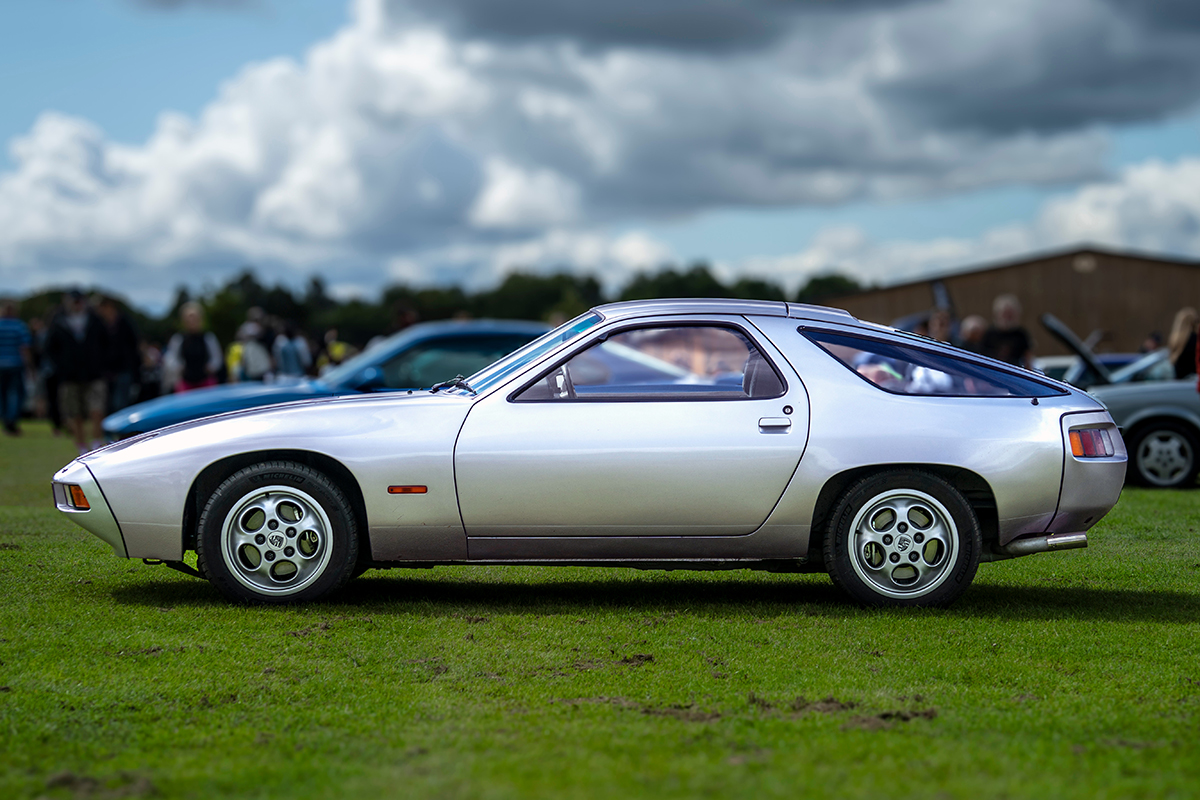
Visually, the Porsche 928 was unmistakable. Its shark-nosed physique, wide stance, independent suspension, and pop-up headlights gave it a futuristic presence without the excess adornments. The Porsche 928 was, however, often misunderstood, lacking the motorsport pedigree of its rear-engined sibling and deemed overly luxurious, which is exactly what Brickman wanted. In the context of Risky Business, the Porsche 928 just felt right; a refined instrument of automotive artistry driven by someone successful, disciplined, and practical. That is, until it fell into the hands of their teenage son.
Four Cars, One Icon
Four Porsche 928 models were used throughout the production of Risky Business. Each served a specific purpose and differed subtly in year, configuration, and mechanical setup, yet cleverly unified to maintain the look of a single vehicle onscreen. Two of the 928 models became the primary “hero” cars, appearing most often and handling the majority of the film’s driving sequences. The remaining two models were modified for use in select scenes, including the memorable pier sequence filmed at Belmont Harbor in Chicago’s Lincoln Park neighborhood.
The first hero car used for the film wasn’t a 1979 model at all, but a modified 1981 Porsche 928 finished in Platinum Metallic. It was the car audiences saw the most in exterior scenes, including memorable chase sequences through the streets of Chicago and portions of Highland Park.
Powered by a 4.5L aluminum V8 engine producing 219 horsepower, the 1981 Porsche 928 could sprint from 0 to 60 MPH in approximately 6.8 seconds and reach a top speed of 143 MPH. It rode on distinctive 15-inch “phone dial” alloy wheels and featured a gold interior. Its five-speed manual gearbox, independent suspension, and Porsche Weissach rear axle contributed to its exceptional balance and stability.
The second hero car was originally a white 1979 Porsche 928, also equipped with a five-speed manual gearbox. Because Platinum Metallic paint was not a factory color option for the 1979 model year, the car was repainted for continuity. Fitted with larger 16-inch alloy wheels and an all-gold interior, the 1979 Porsche 928 appeared in wider exterior shots showing the car fully in view.
Fun fact! As Tom Cruise didn’t know how to drive a standard manual transmission, the film’s producer, Jon Avnet, taught him stick shift in this 1979 Porsche 928 hero car during the film’s first week of production.
The third and fourth Porsche 928s appeared in the Belmont Harbor pier sequence, both 1979 models featuring 16-inch phone dial wheels and repainted in Platinum Metallic. One was used on camera for a controlled downhill roll towards Lake Michigan with no occupants inside after, as scripted, being knocked out of gear with its keys inside.
The other, named the “dump car,” was set upon a rigged wood pier and plunged into Lake Michigan. For this sequence, the dump car was stripped of its V8 engine, transmission, and drivetrain to prevent fluid contamination of the lake. However, these modifications greatly lightened the weight of the 928 and altered its stance on the pier, causing its nose to sit noticeably higher in the finished scene.
More Than a Classic
Considered one of the most iconic films of the 1980s, Risky Business resonates as a modern classic to this day. Sure, its star went on to global fame and fortune, but the long-term impact the film had on the Porsche 928 cannot be overstated. Following the film’s success, what had once been an underappreciated grand tourer became an object of desire by performance car enthusiasts.Nearly forty years after the film’s theatrical release, the 1979 Porsche 928 hero production car from Risky Business crossed the auction block at Barrett-Jackson in September 2021, selling for $1.98 million, a record for the Porsche 928. As a treasured automotive icon once driven on- and off-camera by one of the biggest movie stars in the world, this is not surprising at all.