


Since the dawn of cinema, stunt performers have thrilled audiences with their daring onscreen feats. The first-ever recorded stunt showing rodeo rider Frank Hanaway falling from his horse in The Great Train Robbery (1903). Buster Keaton narrowly avoided being crushed by a falling house in Steamboat Bill Jr. (1928). Yakima Cannutt, perhaps the most famous of all stunt performers, leapt from horseback to a train of horses and slid beneath a speeding stagecoach in John Ford’s classic 1939 western Stagecoach (a stunt recreated by Terry Leonard beneath a speeding truck in Raiders of the Lost Ark more than 40 years later).
These icons and thousands more throughout the last century continue a tradition of fearless innovation, possessing steel nerve and unrelenting audacity to turn physical performance into moments of death-defying foolhardiness for the sake of their art. Few larger-than-life masters of the craft embodied that reckless spirit more than Hal Needham. And, few films pulled back the curtain on the dangerous world of movie stunt work better than Hooper in 1978.
A Legendary Friendship
By the mid-1970s, Hal Needham had become one of the most accomplished stunt professionals in the industry with a resume that stretched across some 4,500 television episodes and 310 films as a stunt performer (breaking his back twice), stunt coordinator, and second-unit director. Hired as the stunt double for a young actor named Burt Reynolds in a 1959 episode of NBC’s series Riverboat, Needham continued serving as his stuntman for more than a decade. As Reynolds’ stardom exploded throughout the early- to mid-1970s, and Needham eager to become a film director, both collaborated on a small $4.5 million Southern-fried road comedy for Universal Studios called Smokey and the Bandit in 1977. It grossed nearly $300 million worldwide to become the second-biggest moneymaker that year, trailing only Star Wars.
Every Hollywood studio now desperately wanted to be in the Burt Reynolds/Hal Needham business, each bombarding them with potential follow-up projects. Needham already had his next project in mind.
Needham’s Passion Project
Since 1974, Needham had been developing a film honoring his fellow stunt performers. Originally titled The Stuntman, the project was pitched to Reynolds, who agreed to star before a script had even existed. At the time, studios had little interest in the concept and were not about to give a stuntman the directing reins on a multi-million dollar production. That all changed after the success of Smokey and the Bandit. Warner Brothers revived the project and commissioned a screenplay from writers Thomas Rickman and Bill Kerby. Needham, now in pre-production on this passion project, changed the title of his action-comedy to Hooper.
The story of “the greatest stuntman…alive,” Sonny Hooper, portrayed by Reynolds in a performance clearly inspired by the experiences of Needham and stunt icon Buddy Joe Hooker, is an aging stunt legend trying to cling to fame after decades of injuries have left him battered, weary, and living with relentless pain. Sonny decides to hang it up once production wraps on the fictional James Bond-esque film being made within Hooper and is determined to leave the game on his own terms, deciding to perform the movie stunt to end all movie stunts.
Rocket-Powered Glory
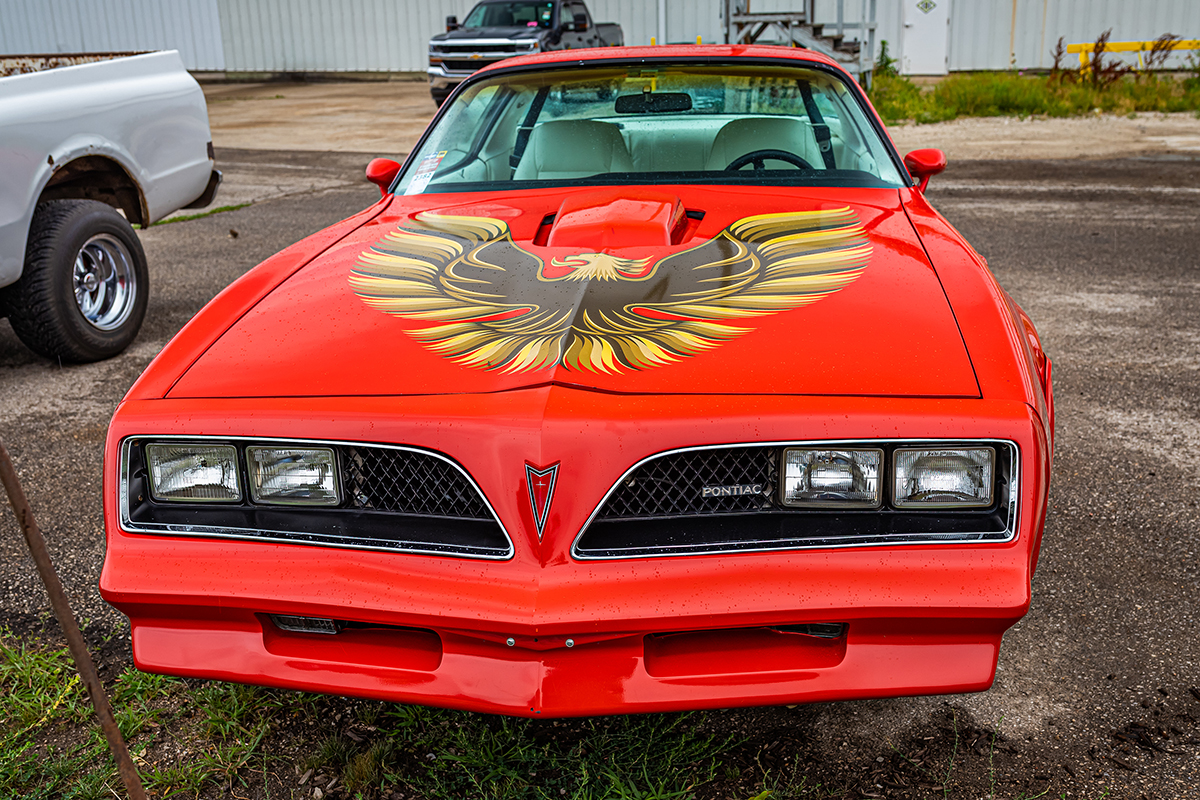
When the film-within-a-film calls for launching a car across a 325-foot chasm, it requires more than fearless nerve. It also needs a hefty dose of ground-pounding torque from a revved-up street shredder to make the feat unforgettable. At the time, the Pontiac Firebird Trans Am was the hottest car on the market following Smokey and the Bandit‘s immense success, which was still going strong at the box office throughout the production of Hooper. Sticking with their high-performance lucky charm, Needham and Reynolds decided Sonny Hooper’s car would be the 1978 Pontiac Firebird Trans Am.
Painted in Mayan Red, the 1978 Pontiac Firebird Trans Am production car housed a 6.6L Oldsmobile-sourced 403 cubic-inch L80 V8 engine beneath its black and gold screaming chicken-emblazoned hood that produced 185 horsepower and 320 pound-feet of torque, matched with a GM Turbo Hydra-Matic 350 three-speed automatic transmission. A factory WS6 Handling Package equipped the car with stiffer leaf springs, 1.25-inch front and 0.75-inch rear anti-sway bars, and a quick ratio 14.0:1 steering box. To give the illusion of a rocket car, the rear seat was removed and replaced with elaborate prop equipment like faux booster components, pressure tanks, and a mock control panel on the center dash. The final touch was the prop booster tube protruding from the rear bumper.
At the same time, the actual rocket stunt vehicle was also being prepped, a retired jet-powered drag racing car outfitted with an exact-matching fiberglass 1978 Trans Am shell that was nose-lengthened for enhanced high-speed stability and aerodynamics. This was the car the filmmakers launched across the Locust Fork River just outside of Birmingham, AL, following a scene involving a scripted bridge collapse. Piloted by Buddy Joe Hooker, the stunt was executed flawlessly. Hooker survived unscathed. The stunt car was destroyed on impact.
In the Hooper script, it was a 325-foot jump; in reality, Hooker’s launch was recorded at 198 feet.
Damnation Alley
Beyond the rocket car launch sequence, Hooper’s climactic simulated earthquake is the other ambitious practical stunt scene in the film, once again featuring Reynolds, co-star Jan-Michael Vincent, and the 1978 Pontiac Firebird Trans Am. For the nearly seven-minute action sequence, Needham, stunt coordinator Bobby Bass, and his team transformed an abandoned World War II military hospital complex and surrounding barracks outside Tuscaloosa, AL, into a massive set of meticulously choreographed chaos and destruction they affectionately nicknamed “Damnation Alley,” a less-than-subtle reference to the 1977 film Jan-Michael Vincent recently starred in.
The 125-acre property was scheduled for demolition at the time of filming, giving Needham and his stunt coordinators carte blanche to literally destroy everything in sight. Surrounded by hundreds of stunt performers, crashing vehicles, fiery explosions, collapsing buildings, and other forms of nightmarish mayhem, the Firebird Trans Am traversed the spectacular devastation in one of the most intense multi-stunt sequences ever captured — including the famous shot of a near-miss by a falling 240-foot-tall brick smokestack — all filmed practically, well over a decade before the inception of computer generated imagery (CGI).
Fun Fact!
The friendship and professional partnership of Hal Needham and Burt Reynolds was so iconic throughout Hollywood history that filmmaker Quentin Tarantino paid tribute to both men by modeling Leonardo DiCaprio and Brad Pitt’s characters from Once Upon a Time…in Hollywood on Burt and Hal. Several years earlier, Tarantino honored Needham’s contributions to filmmaking by presenting him with the Academy of Motion Picture Arts and Sciences’ Governors Award, recognizing a lifetime of achievement in the industry.
An Icon Reborn
Following a short promotional touring stint after filming wrapped, the 1978 Pontiac Firebird Trans Am used throughout the film’s production was, unfortunately, scrapped and crushed immediately afterward for reasons unknown. Loving the film and the car as much as he did, Burt Reynolds had an exact replica of the Hooper retro rocket 1978 Trans Am built, adding it to his Trans Am collection. Following his passing in 2018, Reynolds’ replica 1978 Hooper Trans Am was auctioned by Barrett-Jackson for $88,000 and now resides at the Memory Lane Classic Car Museum in Young Harris, GA.
Saluting the Daredevils
To this day, Hooper remains not only one of the most entertaining films of its era, but also a beloved tribute to the stunt performers of the past, present, and future whose skill, courage, and dedication have helped shape the history of motion pictures. It celebrates these often-overlooked daredevils of the silver screen who put mind, body, and spirit on the line to transform movie stars into legends.
Proving, as Bent Myggen’s theme song to Hooper says, there ain’t nothin’ like the life of a Hollywood stuntman.