


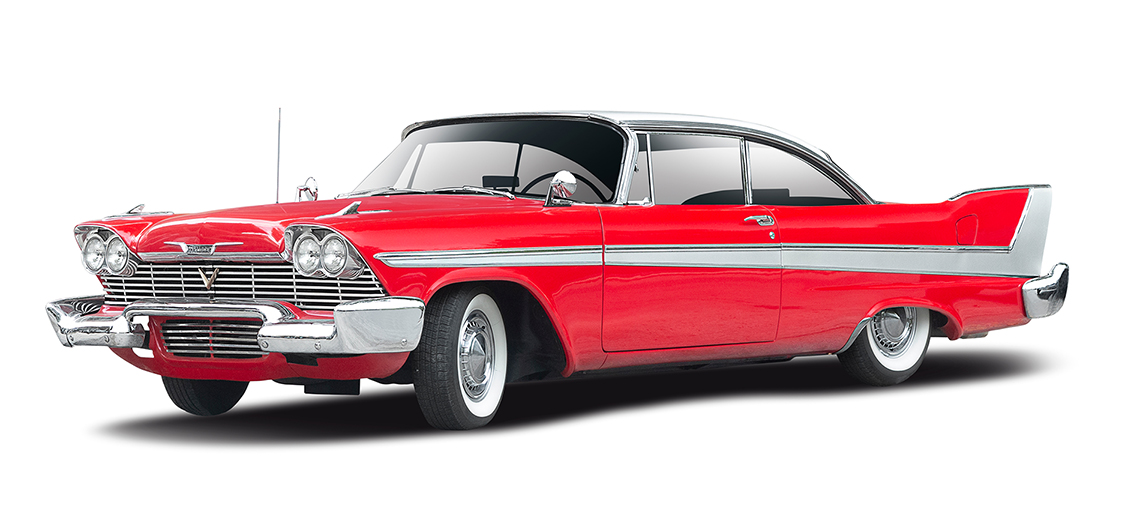
“She lives. She loves. She’s a beauty. She’s a killer. She’s a ‘58 Plymouth Fury.” — from the Christine movie trailer
She rolls upon a dark and haunted road with nobody behind her blacked out windows. Silent. Stealthy. Deadly. Her headlights ablaze like wide-open irises on the prowl for those who did her wrong. Her revving V8 engine snarls with something sinister and unnatural, a supernatural presence that shocks and terrifies, controlled by forces unknown and unseen. This is not merely a steel machine built on a Detroit assembly line, but a malignant force of evil. Beneath her blood red and white visage and gleaming chrome, she is a possessed vessel of hate and vengeance that cannot possibly be alive, but was born to be bad.
She’s a 1958 Plymouth Fury.
She’s Christine.
According to author Stephen King, the genesis for his novel Christine began in 1978 while on a walk home one hot summer afternoon after his aging vehicle broke down. The idea of a car reversing its own aging process, getting younger and younger until it finally ended up a heap of shiny new components. With that premise, King began work on what would become his 13th novel, a number that also includes titles King wrote throughout the 1970s under his pseudonym, Richard Bachman. King deliberately chose the 1958 Plymouth Fury as his novel’s devilish hellraiser because it was a “forgotten car” in the annals of automotive history; a steel and chrome beauty lost to time but with a model name that coincidentally matched its menacing temperament. By the time the novel Christine was released in bookstores worldwide on April 29, 1983, legendary horror filmmaker John Carpenter was already well into production on its film adaptation.
Gathering the Evil Fleet
Of the 24 Plymouth models acquired for the production in varying conditions to convincingly portray Christine’s phased metamorphosing, only a fraction were authentic Plymouth Fury models. Because of their resemblance, several late 1950s-era Plymouth Belvedere and Savoy models were disguised as Furys following minimal body alterations. Of the 24 cars at their disposal, 17 drivable Christine vehicles were used on location, each with a unique on-screen purpose — high-speed stunts, fiery street collisions, showroom-polished models for beauty shots, and stripped down versions outfitted with strategically placed hydraulics for the film’s infamous regeneration sequence. More on that later.
A Rare and Feisty “Possession”
A rarity even for its time, Plymouth produced just 5,303 Fury units in 1958, every last one of them painted in Sandstone White with a Buckskin Beige interior. The Fury in King’s novel was a custom-order for the novel’s spitefully bitter antagonist, Roland D. LeBay, at the fictional Norman Cobb Plymouth dealership in Libertyville, PA. It was the only model rolling off the Plymouth assembly line that year bearing a sleek Autumn Red exterior paint finish with white accents and boasting vinyl seat upholstery that was described in the book as “red as a fire engine on the inside.” Powering this rolling demon was a 350-cubic-inch V8 engine with 10:1 compression, rated at 300 horsepower and paired with a futuristic Chrysler three-speed TorqueFlite push-button automatic transmission. At 3,500 pounds, the Fury was a middleweight by 1950s standards but had enough punch to back up its dazzling allure.
One of the Fury’s visual signatures was its anodized gold trim and distinctive rear fender script. Because sourcing such trim pieces for dozens of movie cars was nearly impossible, Carpenter’s production crew instead dressed their fleet in the more common Belvedere “Dartline” trim. With creative detailing, filmgoers saw multiple Plymouth Fury models on-screen, even though “under the skin,” they were other models.
With a cast primarily made up of unknowns at the time, Carpenter devoted nearly 15 percent of his production budget — a significant sum — to acquiring and modifying all 24 cars. This gave the filmmakers almost unlimited capability to crash, crumple, flatten, burn, repair, and resurrect Christine repeatedly with no risk of running out of usable vehicles or parts. Deeming the rumble of the original Fury’s V8 engine not menacing enough, Carpenter decided to incorporate the menacing roar of a 1970 Ford Mustang 428 Super Cobra Jet into each scene in post-production, enhancing the sonic brunt of her rage-fueled vengeance.
Fury Reborn
“Okay. Show me,” Arnie Cunningham tells Christine, his high-octane obsession, as she rests in a wrecked and shattered state in stall 20 of Darnell’s Do-It-Yourself Garage. And show him she does, regenerating herself in one of the most jaw-dropping practical effects sequences ever filmed. Originally, Carpenter had no intention of filming the scene due to budgetary reasons, but had a change of heart after production wrapped when special effects supervisor Roy Arbogast came up with a rather ingenious low-tech idea for how to make it happen.
Crafting soft plastic body mold panels and installing them on two different stripped down Fury replicas, Arbogast and his crew carefully fitted dozens of hydraulic mechanisms throughout the car. Strategically placed pumps and taut cables allowed the mold panels to be compressed and crumpled inward one section at a time as second-unit cameras rolled film, simulating catastrophic crash damage. When this footage was played in reverse, the stunning effect looked as if the car was fully restoring itself before our eyes.
A Sinister Legacy
Once principal photography on Christine concluded, only three intact cars survived the production, used briefly as promotional tools for the film before being acquired by private collectors. One of the three surviving screen-used Christine models — documented as “Car #14” and autographed by Stephen King on the dashboard when it appeared decades later on the set of 11/22/63, another King novel adaptation — spent five years on display in the Chicagoland area at Volo Auto Museum in northwest suburban Volo, IL, before being sold to a vintage car collector earlier this year.
More than 40 years after its release, Christine is as iconic a contemporary horror film classic as they come; an impossible premise brought to terrifying reality in book form and on film by two master storytellers. King gave Christine her soul; Carpenter gave her form. Both gave this deadly and haunted vessel a bad reputation, one that turned her into a frightening cultural phenomenon; she’s a bad seed that seared herself into the memories and nightmares of horror fans worldwide for over four decades.
Some beauties are impossible to forget.