


The summer of 1996 was a banner year for the American movie blockbuster. With numerous action spectacles on the release roster, the domestic box office competition was steep, with each cinematic juggernaut contributing to one of the most profitable summer movie seasons in Hollywood history. Kicking off that adrenaline-charged summer lineup was a literal force of nature, a big-budget disaster epic powerful enough to clear a massive path toward the multiplexes for all else that followed.
On May 10, 1996, the storm clouds rolled in and the floodgates opened. Twister had arrived.
Reuniting Steven Spielberg and author/filmmaker Michael Crichton, both red hot following their collaboration with the record-shattering smash hit Jurassic Park three years prior, and recruiting director Jan De Bont, whose high-intensity classic, Speed, flipped the tables on action filmmaking style two years prior, Twister was poised to become one of the biggest event films of the year.
“It’s the Wonder of Nature, Baby!”
With monstrous tornadoes dominating this $95 million (approximately $197 million in 2026 dollars) visual effects extravaganza, Twister often leaves its brave storm chasers sharing the spotlight with the vehicles they drive. Navigating the hazardous terrain and relentless conditions caused by these towering behemoths throughout the Oklahoma Plains required old-school workhorse power, agility, and hardcore 4×4 performance.
The Storm Chasers
1982 Jeep J-10 Honcho
Scratched, dented, and ready for the pursuit, the weathered 1982 Jeep J-10 Honcho reflects the determination and obsessively adventurous spirit of its owner, Dr. Jo Harding, portrayed by Helen Hunt. Finished in Sun Yellow paint with bright blue Honcho graphics, the Twister J-10 showcased one of the Jeep brand’s boldest options from the 1980s, the Honcho Package. Available only on short-bed Sportside models, the Honcho Package included distinctive blue graphics, chrome trim, an optional grille guard, a factory-installed tubular roll bar, ten-hole steel wheels, KC off-road lights mounted on the grille guard and roll bar, and other aggressive styling features.
The film production acquired four Jeep J-10 Honcho trucks, ranging from 1982 and 1984 models, each modified for a consistent on-screen appearance. Powered by a 360 cubic-inch 5.9L AMC V8 engine that generated around 195 horsepower and mated with a three-speed automatic transmission, each J-10 Honcho model was reconfigured based on its use in the film, including 2- to 3-inch lift kits added to the factory suspension for improved ground clearance during rougher stunt work.
1995 Dodge Ram 2500
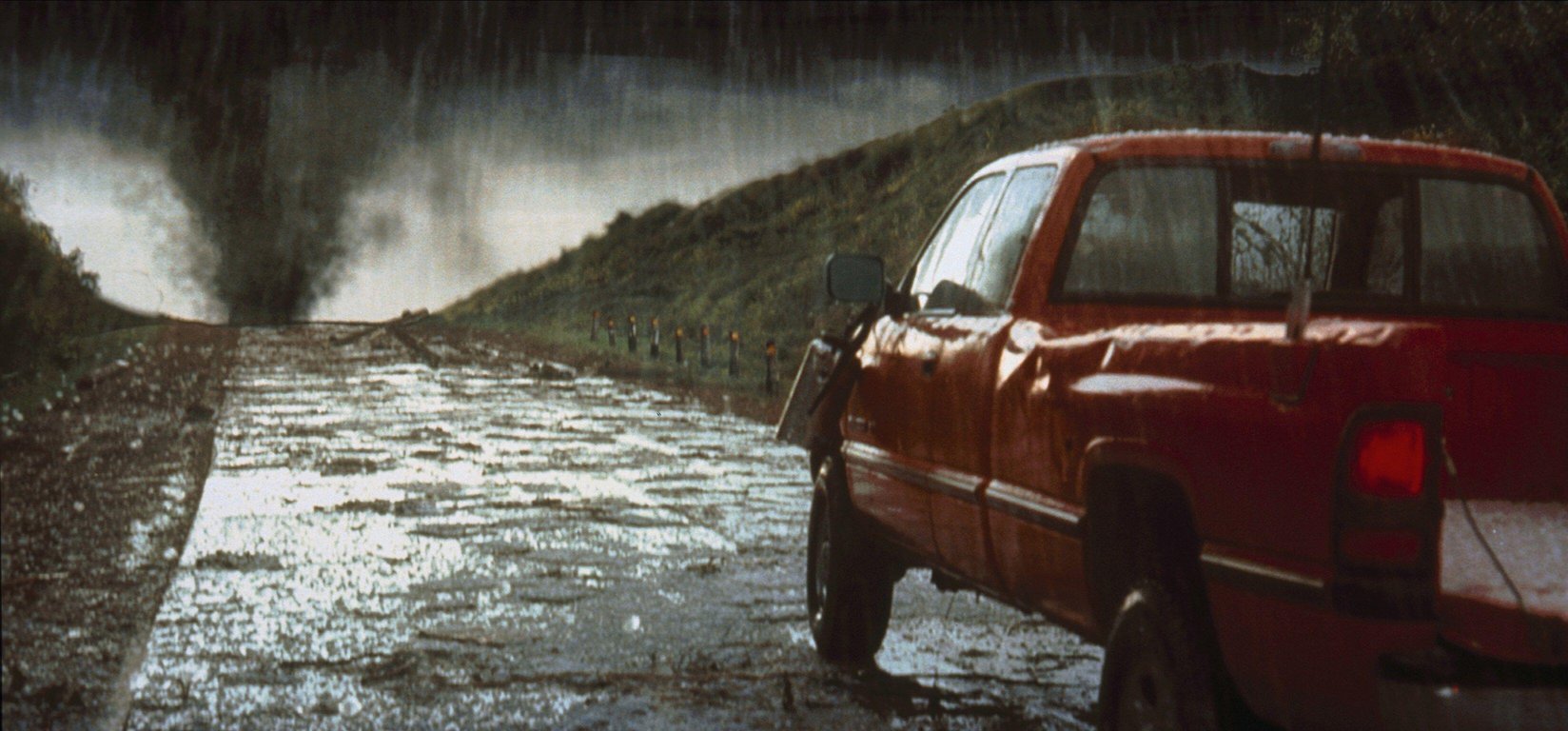
Reflecting the gut instincts and fearless persistence of Bill “The Extreme” Harding, played by Bill Paxton, his 1995 Dodge Ram 2500 fit right into the film’s blustering chaos. Under ownership by Chrysler Corporation at the time, Ram was not yet a standalone brand — which it would not become until 2009 — and their truck lineup was officially designated the Dodge Ram. Dodge supplied six four-wheel-drive (4WD) extended cab pickup trucks to the production, including both Ram 1500 and Ram 2500 models. For sharp-eyed viewers, an early driving scene featuring Bill’s truck briefly reveals Ram 3500 badging, an obvious continuity error considering the production utilized only Ram 1500 and Ram 2500 models throughout filming.
Just before production began in May 1995, Dodge launched this second-generation Ram, complete with an all-new design sporting sweeping fenders and rounded, aggressive bodylines. Beneath the hood of each 1995 Dodge Ram 2500 model was a massive 488 cubic-inch 8.0L Magnum V10 engine that produced 300 horsepower, while the Ram 1500 models housed a 360 cubic-inch 5.9L Magnum V8 powertrain with an output of 230 horsepower.
Each of the six Dodge Ram trucks was configured for specific filming purposes, including a hero vehicle for close-ups, others equipped for stuntwork and practical effect sequences, and another rigged for camera mounts on the front, rear, and sides.
“It Was Windy”
Both the 1982 Jeep J-10 Honcho and 1995 Dodge Ram 2500 production vehicles endured relentless punishment throughout the demanding four-month production of Twister, which was filmed on location across Oklahoma and Iowa. To simulate hurricane-force winds, the production crew towed the Ram models behind an operating Boeing 707 jet engine, pummeling the trucks, actors, and stunt doubles with ice chunks (standing in for tornado-driven hail), dirt, rocks, branches, and other debris.
A scene involving a tornado slamming down on a rural road in front of the Ram 2500 required such an immense amount of practical effect ice and debris that all six Ram production trucks were used to complete the sequence, as blown tires and shattered plexiglass windshields required frequent replacement. Spectacular sequences involving heavy farming machinery falling from the sky and a tanker truck exploding in front of the Ram 2500 also relied on practical effects. The force of the carefully planned blast unexpectedly knocked the rapidly approaching Ram several feet sideways and splintered its plexiglass windshield. Footage of the unforeseen windshield damage captured by a front passenger seat-mounted “B” camera was so dramatic, director Jan De Bont kept it in the final cut of the film.
Beyond its exciting practical effects, Twister featured some of the most groundbreaking visual effects of its time. George Lucas’s Industrial Light & Magic (ILM) utilized their new Dynamation system and its particle simulation technology to create realistic digital tornadoes, filling the screen with jaw-dropping images of these swirling monsters of nature mercilessly unleashing their 300 MPH wind-funneled chaos. The film’s intense sound design heightened the terror of each tornado sequence, with sound editors layering distorted, slowed-down recordings of jet engines, lion roars, tiger growls, and camel moans, to generate the snarling, animalistic menace of these violent storms.
Fun Facts!
Despite being one of his most memorable performances, Bill Paxton wasn’t the original star cast as Bill “The Extreme” Harding in Twister. Tom Hanks was offered the role and spent a few weeks in wardrobe fittings and rehearsals before backing out of the project. Co-starring with Paxton in Apollo 13 the prior year, Hanks recommended him to De Bont and executive producer Steven Spielberg. Leading into the digital age of home video, Twister was the first film released on the new DVD format when it was launched in October 1997.
Life Beyond the Storm
Only two of the four 1982 Jeep J-10 Honcho models used in the production of Twister survived. One currently resides at the Hollywood Star Cars Museum in Gatlinburg, TN, while the other was obtained and restored by a private collector in Guthrie, OK. None of the six screen-used 1995 Dodge Ram models exist today. Most were damaged beyond repair throughout the film’s production, and all six were crushed after the completion of principal photography as per an insurance liability agreement between Dodge and Warner Bros. With its $494 million global box office haul, Twister became the second highest-grossing film of 1996.
Three decades later, Twister remains one of Hollywood’s defining and most beloved disaster films, even spawning a sequel-of-sorts with 2024’s Twisters. Its fandom is worldwide, with the more dedicated building exact-matching recreations of both vehicles, complete with a barrel-shaped “DOROTHY” tornado telemeter secured in the bed, that appear at auto shows, exhibits, and annual Twister events throughout the country.
If Twister defined cinematic spectacle, then both the 1982 Jeep J-10 Honcho and the 1995 Dodge Ram 2500 defined courage, driving us all straight into the eye of the storm.